Guide
What is Coast FIRE? How to find your Coast FIRE number
Published
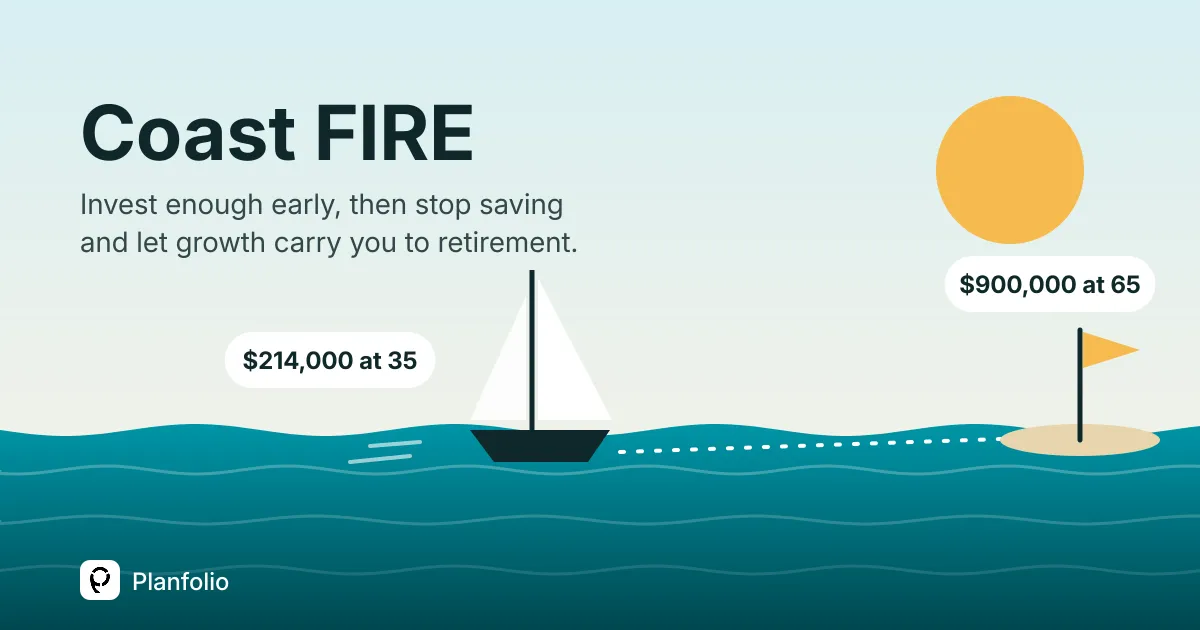
Coast FIRE means you have invested enough that, without saving another dollar, growth alone takes your portfolio to your FI number by the time you retire. You keep working to pay your living costs, but you can stop saving for retirement. The amount you need invested for that is your Coast FIRE number: your FI number divided by your portfolio’s growth until retirement.
How to calculate your Coast FIRE number
You need three numbers:
- Your FI number: the portfolio that pays your spending in retirement. With the 4% rule it is 25 times your yearly spending: $3,000 a month is $36,000 a year, so $900,000.
- The years until you retire: at 35, retiring at 65, that is 30.
- Your expected return after inflation: 7% a year with 2% inflation is about 4.9%.
Then:
Coast FIRE number = FI number ÷ (1 + return after inflation)years until retirement
$900,000 ÷ 1.04930 = $900,000 ÷ 4.2 = about $214,000
With $214,000 invested at 35, you could stop saving today. At 4.9% a year after inflation, it grows to $900,000 in today’s money by 65.
The Coast FIRE calculator does this month by month with your own numbers, and also shows the month you can stop saving.
Coast FIRE numbers by age
The same plan for every age: $3,000 a month in retirement, retirement at 65, a 7% return, 2% inflation and the 4% rule.
| Age today | Years until 65 | Coast FIRE number |
|---|---|---|
| 25 | 40 | $133,000 |
| 30 | 35 | $169,000 |
| 35 | 30 | $214,000 |
| 40 | 25 | $272,000 |
| 45 | 20 | $346,000 |
| 50 | 15 | $439,000 |
Every five years you wait, the number grows by about 27%. At 25 the market has 40 years to do the work, at 50 only 15. That is why Coast FIRE is mostly a plan for your 20s and 30s.
Are you already coasting?
Compare what you have invested today with the Coast FIRE number for your age:
- Above it: you are coasting. You could stop saving and still reach your FI number by retirement, as long as returns hold.
- Below it: keep saving. You reach your coast point in the month your portfolio meets the coast line.
The coast line is not a fixed target. It is your FI number discounted back to each month, so it rises every year at your expected return. Growth alone only keeps pace with it: you close the gap with what you add.
Example: you are 30, have $50,000 invested and save $1,500 a month. Your Coast FIRE number is $169,000. Saving $1,500 a month, your portfolio meets the coast line in July 2035, at 38, after $207,500 paid in. From then on, it needs no more money to reach $900,000 by 65.
With $40,000 and $1,000 a month instead, the same plan coasts only at 49. Because the coast line keeps rising, a smaller savings rate stretches the date a lot.
What can push you off the coast line
Once you stop saving, no new money comes in to make up for a shortfall. Four things to watch:
- Lower returns than planned. The coast number depends heavily on the return. At 35, the same plan needs $162,000 at 8%, $214,000 at 7% and $284,000 at 6%. If you coast with $214,000 and the market returns 6% instead of 7% for 30 years, you reach about $679,000 by 65, not $900,000: a quarter short.
- Higher spending. Your FI number rests on what you plan to spend in retirement. If your life gets more expensive, your FI number and your coast number rise with it.
- Higher inflation. It lowers your return after inflation, the same way a weaker market does.
- Withdrawals. Coast FIRE assumes you leave the portfolio alone until retirement. Every withdrawal comes off the money that is meant to compound.
The answer is the same for all four: check at least once a year whether your real portfolio is still on or above the coast line, and start saving again if it falls below. Are you on track for FIRE? shows how to read that gap.
Coast FIRE vs FIRE and Barista FIRE
- FIRE: you save until your portfolio pays all your costs, then stop working. You need the full FI number, $900,000 in the example.
- Coast FIRE: you stop saving early but keep working until retirement, because your income still pays your costs. You need the coast number, $214,000 at 35.
- Barista FIRE: you leave full-time work early. Your portfolio pays part of your costs and part-time income pays the rest. You need more than for Coast FIRE and less than for FIRE: Barista FIRE: how much part-time income do you need?
FAQ
What is a good Coast FIRE number?
There is no single number: it depends on your spending, your age and the return you assume. With $3,000 a month of spending and retirement at 65, it is about $169,000 at 30 and $272,000 at 40 (see the table above).
Does Coast FIRE include Social Security or a pension?
Not in the numbers above. If you will get a pension, your portfolio has to pay less: subtract the pension you expect from your monthly spending before you work out your FI number. That lowers your coast number too.
What return should I assume?
A lower return gives you a larger coast number and a safer plan. If you are not sure, run your plan with one percentage point less than you expect and see how much the number moves.
Can I quit my job once I am coasting?
Not completely. Your income still has to pay your living costs until retirement. You can move to a job that pays less, work part-time or take a break, as long as your income covers your costs. If your portfolio has to pay part of them, you are planning Barista FIRE.
Track whether you are still coasting
A calculator gives you the coast number once. Whether you stay on the coast line depends on your real portfolio, year after year. Planfolio is a portfolio tracker that checks it for you:
- All your brokerage accounts in one place, so you compare the coast number with your whole portfolio, not one account.
- Your plan under Plan > Goal: set your savings plan to drop to 0 from your coast date, and the app compares your real portfolio with that plan every month.
- Ahead or behind plan, split into what you invested and what your return did, and your FI date adjusted to where you really are.
- Private by design. Your financial data is end-to-end encrypted.
The plan and the progress bar are free. The adjusted FI date and the ahead or behind breakdown are part of Planfolio Pro.
Planfolio is an information tool, not investment advice. Projections rest on the assumptions you enter, and markets don’t follow them.
Try it
Find your number in the Coast FIRE calculator, then set up the same plan in Planfolio and track your real portfolio against it.