Guide
Portfolio health check: 5 things to review once a year
Published · Updated
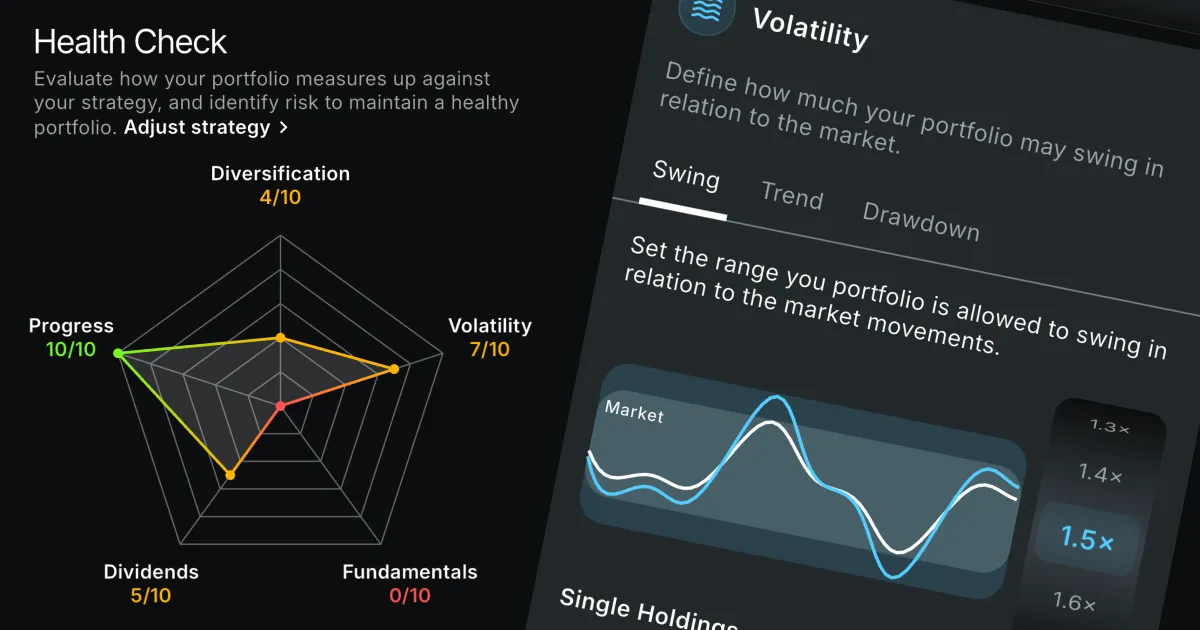
A portfolio health check compares your portfolio with your own strategy, not with someone else’s model portfolio. Once a year, review five areas: diversification, volatility, fundamentals, dividends and progress toward your plan. Set a target for each first. Then the check is simple: where is the gap, and which positions cause it?
Why your own targets, not a generic score
The same portfolio can suit one investor and worry another. A large tech share can be a deliberate choice for someone with a 30-year horizon and a risk for someone who needs the money in three years. A generic score doesn’t know your horizon, your income needs or how much swing you can sit through. Write your targets down first, then measure against them.
1. Diversification: is your money spread the way you intended?
- Asset mix: stocks, bonds, cash and crypto against your target split.
- Regions: for example, how much is in the US, Europe and emerging markets.
- Sectors: no sector above the cap you set.
- Single positions: no single company above the cap you set.
Look through your ETFs before you judge. A world ETF, an S&P 500 ETF and a tech ETF all hold the same large US companies, so your largest real position is often a company you never bought directly.
2. Volatility: does the ride match what you can sit through?
Compare how much your portfolio swings with the market, not in absolute terms. In a crash almost everything falls. What matters is whether your portfolio falls much more than the market.
- Portfolio swing: the volatility of your portfolio relative to a benchmark, for example at most 1.5 times the market.
- Single holdings: positions that swing far more than the market.
- Trend: whether your portfolio swings more than it did 12 months ago.
- Drawdown: your largest drop compared with the market’s largest drop.
Because every number is relative to the benchmark, a market-wide crash doesn’t count against you. A portfolio that quietly became riskier does.
3. Fundamentals: are the companies you own healthy?
For stocks, look at quality, not only at the price: profitability, debt, growth and how expensive the stock is. Set a minimum and see which holdings fall below it. Then check whether your holdings still fit the style you chose, for example growth, value or dividends.
4. Dividends: is your income growing, and is it safe?
Only if you invest for income:
- Yield and income growth: your dividend yield over the last 12 months against your target, and whether your income grew compared with the 12 months before.
- Growth per share: whether the companies raised their dividend per share. This separates company growth from your own new purchases.
- Cuts: which of your payers cut their dividend.
- Payout ratio: a company that pays out more than it earns may not keep it up.
- Concentration: how much of your income depends on a single payer.
5. Progress: are you on track for your plan?
Compare your real portfolio with your plan: what you invested against what you planned, your return against the expected return, and whether your financial independence date moves. How that works, with a worked example: are you on track for FIRE?
How to run your yearly check
- Write down a target for each area, if you haven’t yet.
- Look through your ETFs before you judge concentration.
- Note each gap and the positions that cause it.
- Close gaps with new money first. Putting new savings into the parts that are underweight closes gaps without selling, which can cost fees and taxes.
- Change targets after life changes, not after every market move.
How Planfolio runs the health check
You set your targets under Plan > Strategy. The health check scores each of the five areas from 0 to 10 on a radar chart:
- Every lost point has a reason. Each score breaks down into named checks that pass or fail, for example “stocks 38%, target 30%”.
- Your ETFs are looked through. The Holdings X-ray counts what your ETFs hold, so concentration checks see your real exposure.
- Fundamentals come from six quality scores per holding: health, growth, margin, price, return and stability.
- Volatility is measured against a benchmark, with a swing range you choose.
- Findings link to positions, so you see which holdings cause a gap.
- Areas you don’t use stay out. Switch off dividends if you don’t invest for income.
The check describes gaps. It never tells you to sell. To fill it with your real portfolio, import your history first, for example with the Trade Republic export. You can also ask ChatGPT or Claude to explain your scores.
FAQ
How often should I do a portfolio health check?
Once a year is enough for most investors, plus after a big change in your life or a large deposit or withdrawal. In Planfolio the scores follow your portfolio, so you can look whenever you want.
What is good diversification?
There is no single answer. It depends on your strategy, your horizon and how much swing you accept. A health check tells you whether your portfolio matches the targets you chose.
Planfolio is an information tool, not investment advice.
Try it
Open Plan > Strategy in the app, set your targets and run the health check.