Guide
Are you on track for FIRE? How to track financial independence
Published · Updated
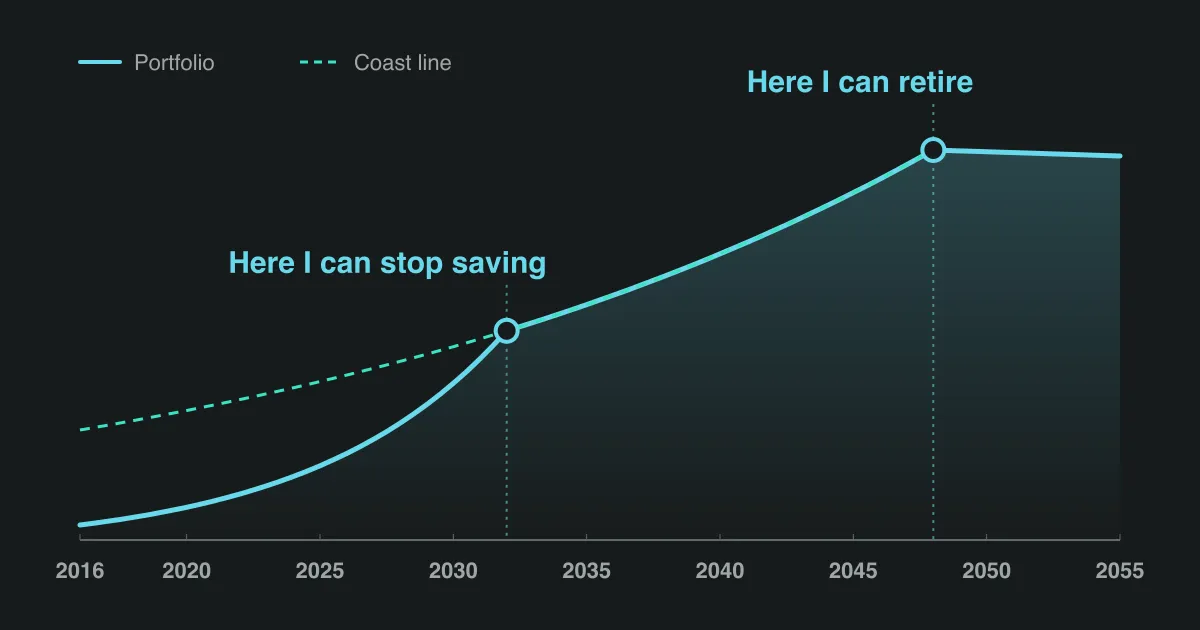
To know if you are on track for FIRE, compare your real portfolio with the balance your plan expected for today. If you invested less or earned less than planned, your financial independence (FI) date moves later. If you are ahead, it moves earlier. A FIRE calculator gives you the plan; only tracking your real portfolio tells you whether reality follows it.
Step 1: a plan you can measure against
FIRE stands for Financial Independence, Retire Early. A plan you can track needs three numbers:
- Your FIRE number: the portfolio value at which your investments cover your living costs. With the 4% rule it is 25 times your yearly spending: $2,500 a month is $30,000 a year, so about $750,000.
- Your savings rate: what you invest each month.
- An expected return: best in today’s money (after inflation), so a million in 2050 is not mistaken for a million today.
From these, a projection grows your portfolio month by month. It gives you two things: the month you reach your FIRE number, and the balance you should have on every date along the way. That second number is what you track against.
The FIRE calculator builds this plan in a minute and compares three withdrawal strategies: continue growing, preserve capital or spend it down.
Step 2: compare your real portfolio with the plan
Once a month, put two numbers side by side: your actual balance and the planned balance for today. The gap has two sources, and it matters which one it is:
- You invested more or less than planned. Missed or extra savings. This does not fix itself.
- Your return was higher or lower than planned. Market swings, fees or your mix of investments. A weak year often evens out; a return that lags for years does not.
Your FI date then follows from your actual balance: project it forward with your planned savings and return, and see when it reaches your FIRE number. The difference to your planned FI date is the number to watch.
A worked example
A plan from January 2022: $30,000 invested, $1,500 a month, 5% a year after inflation, and $2,500 a month of spending after FI. The FIRE number is $750,000 and the planned FI date is March 2043.
In October 2026:
| Plan | Actual | |
|---|---|---|
| Invested | $115,500 | $106,500 |
| Balance | about $133,800 | about $122,300 |
The portfolio is about $11,600 or 8.7% behind plan:
- $9,000 is invested less: the savings paused for six months during a move.
- About $2,600 is lower return: a weak first year in the market.
Projected forward, the FI date moves from March 2043 to September 2043, six months later. Investing $100 more a month brings it back to March 2043.
The market dip felt worse, but the paused savings caused most of the gap. You only see that when you split the gap into its two sources.
Five signals you are off track
- Your savings fall behind the plan. Check what you actually invested, not what your standing order says. Catch up, or lower the plan honestly.
- Your return lags the plan for more than a year. One bad year is normal. Several years below plan point to high costs, too much cash or an expected return that was too optimistic.
- Your spending has grown. Your FIRE number rests on what you planned to spend. If your life costs more today, your target is too low. Update the spending and look at the new date.
- Your FI date keeps moving later. A single shift is noise. A trend over several months is a signal.
- You can’t see your whole portfolio. With accounts at several brokers, nobody adds it all up, and you track a part instead of the whole.
FIRE, Coast FIRE and Barista FIRE: what to track
Each FIRE model has a different plan, so you watch something different:
- FIRE: you save until your portfolio reaches your FIRE number, then stop working. Track the gap to your planned balance and your FI date. Try the FIRE calculator.
- Coast FIRE: you invest enough early that growth alone reaches your FIRE number by a normal retirement age, then stop saving. After the coast point there are no new savings as a buffer, so check regularly that your real portfolio is still on the coast line. How the number works: What is Coast FIRE?
- Barista FIRE: you leave full-time work once part-time income plus your portfolio cover your costs. Track whether your portfolio still covers the gap your part-time income leaves. How much you need: Barista FIRE: how much part-time income do you need?
Lean and Fat FIRE use the same math with a smaller or a larger spending target. All calculators are on the free tools page.
FAQ
How often should I check my FIRE plan?
Once a month for the balance. Once a year, or after a big change in your life, for the assumptions: spending, savings and expected return.
Is the 4% rule still safe?
It is a good starting point for a 30-year retirement. If you plan to retire early and need your money for 40 years or more, many people choose 3% to 3.5% to be on the safe side.
What should I do if I am behind my plan?
Check which part of the gap it is. Savings that fell behind usually need action: save a little more, plan to spend a little less, or accept a later date. A weak market year often evens out. In the example above, $100 more a month closes a six-month delay.
Do I need a calculator or an app?
A calculator answers “when?” once. An app that tracks your real portfolio answers “am I still on track?” every month. Start with the FIRE calculator, then track the plan in Planfolio.
How Planfolio tracks your progress toward FIRE
Planfolio is a portfolio tracker built around this loop. You set your plan once under Plan > Goal, and the app checks your real portfolio against it:
- All your brokerage accounts in one place. Sync or import your holdings from your brokers, so the plan runs against your whole portfolio, not one account.
- Your FI date, planned and adjusted. The answer comes first: “Financially free in Jul 2040”, and how many months earlier or later than planned.
- Ahead or behind plan. A progress bar toward your FI target and a verdict such as “8.7% behind plan”, split into what you invested and what your return did, like the example above.
- The same math as the calculators. The FIRE, Coast FIRE and Barista FIRE calculators use the same formulas as the plan in the app, so the numbers match when you move from the web to your phone.
- Private by design. Your financial data is end-to-end encrypted.
The plan and the progress bar are free. The adjusted FI date and the ahead or behind breakdown are part of Planfolio Pro. Your progress also feeds the Progress score of the portfolio health check.
Planfolio is an information tool, not investment advice. Projections rest on the assumptions you enter, and markets don’t follow them.
Try it
Run your numbers in the FIRE calculator, then set up the same plan in Planfolio under Plan > Goal and track your real portfolio against it.