Guide
Barista FIRE: how much part-time income do you need?
Published
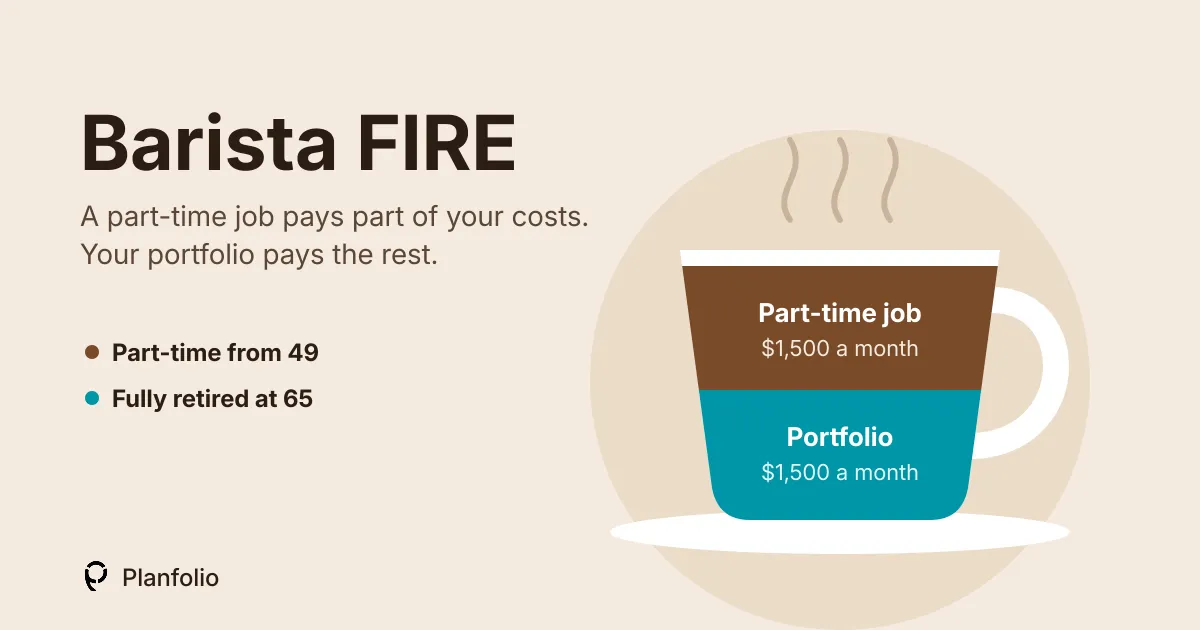
Barista FIRE means you leave full-time work before you reach your full FI number. A part-time job pays part of your living costs, your portfolio pays the rest, and the portfolio still grows into your FI number by the time you fully retire. How much part-time income you need depends on how much you have invested: the more you have, the less you need to earn.
How much part-time income you need
Example: you are 40, spend $3,000 a month and want to fully retire at 65 with $900,000, which is 25 times your yearly spending (the 4% rule). With a 7% return and 2% inflation, this is the part-time income you need to switch today:
| Invested today | Part-time income you need per month |
|---|---|
| $300,000 | about $2,840 |
| $400,000 | about $2,270 |
| $500,000 | about $1,700 |
| $600,000 | about $1,130 |
| $700,000 | about $560 |
A rule of thumb from this table: every $100 a month of part-time income replaces about $17,500 of portfolio. That holds for 25 years until retirement. With fewer years to go, each $100 replaces less, because the portfolio has to pay the gap for a shorter time.
At $272,000 the part-time income would have to cover all $3,000. That is Coast FIRE: your income pays all your costs and the portfolio grows on its own. Below that, part-time work is not enough and you need to keep saving.
The Barista FIRE calculator works this out with your own numbers and shows the month you can switch.
How the Barista FIRE number works
Your Barista FIRE number is what you need invested to switch to part-time work today. It has two parts:
- Your Coast FIRE number: your FI number discounted back to today with your return after inflation. At 40, that is $272,000. How it works: What is Coast FIRE?
- The gaps until retirement: your spending minus your part-time income, every month until you fully retire, valued in today’s money.
At 40 with $1,500 a month of part-time income, the gap is $1,500 a month for 25 years. Its value today is about $263,000, so your Barista FIRE number is about $535,000. From the switch, your portfolio pays the gap and still reaches $900,000 by 65.
When can you switch? A worked example
You are 30, have $50,000 invested, save $1,500 a month and spend $3,000 a month. The rest of the plan is the same: retirement at 65, a 7% return, 2% inflation. Your part-time income decides when you can leave full-time work:
| Part-time income per month | Go part-time at |
|---|---|
| $1,000 | 51 |
| $1,500 | 49 |
| $2,000 | 47 |
| $2,500 | 43 |
| $3,000 (covers everything) | 38, but only stop saving |
Each extra $500 a month brings the switch forward by two to four years. At $3,000 your job pays all your costs, so the portfolio is not touched before 65: that is Coast FIRE, and you get there much earlier, at 38. The difference is that you still need a job that pays your full costs.
What makes Barista FIRE work, or break
- Part-time income that lasts. The plan assumes you earn it every month until retirement and that it rises with inflation. If the job ends, your portfolio has to pay the full gap.
- Health insurance. In the US, a part-time job that comes with health insurance is worth more than its paycheck. That is where the name comes from: coffee chains that offer benefits to part-time baristas.
- Market returns. Your portfolio pays the gap and grows at the same time, so a weak market in the first years hurts twice: you sell when prices are low. Calculators assume a steady return; real markets don’t deliver one.
- Taxes. Enter your part-time income after tax. Withdrawals from your portfolio can be taxed too, so plan some room for that.
- A pension. Social Security or a pension is not included in the numbers above. If you will get one, your plan is on the safe side.
Check once a year whether your real portfolio is still at or above the barista line. If it falls below, earn a little more, spend a little less or save again for a while.
Barista FIRE vs Coast FIRE and FIRE
For the 40-year-old above, spending $3,000 a month:
| What you do until 65 | What you need invested at 40 | |
|---|---|---|
| Coast FIRE | Work in a job that pays all your costs, stop saving | $272,000 |
| Barista FIRE | Work part-time for $1,500 a month, the portfolio pays the rest | $535,000 |
| FIRE | Stop working, the portfolio pays everything for good | $900,000 |
FAQ
What counts as part-time income?
Any income you earn after you leave full-time work: a part-time job, freelancing, consulting, a small business or rent. What matters is that it comes in regularly and covers part of your costs.
Is Barista FIRE the same as semi-retirement?
Close. Semi-retirement is the lifestyle, and Barista FIRE is the math that tells you when you can afford it: the month your portfolio can pay the gap and still reach your FI number.
What if my part-time income is higher than my spending?
Then your portfolio pays nothing until retirement, and your number is the Coast FIRE number. If you also invest the extra income, you will be ahead of your plan.
Do I need a full FI number for Barista FIRE?
Not before you switch. You need the Barista FIRE number, which is lower. Your portfolio grows into the full FI number by the time you fully retire.
Track it in Planfolio
The plan in the app doesn’t include part-time income yet, so use the Barista FIRE calculator for your switch date. Until you switch, Planfolio tracks what decides it:
- All your brokerage accounts in one place, so you compare your Barista FIRE number with your whole portfolio, not one account.
- Your savings plan under Plan > Goal, compared with your real portfolio every month: ahead or behind plan, split into what you invested and what your return did.
- Private by design. Your financial data is end-to-end encrypted.
The plan and the progress bar are free. The ahead or behind breakdown is part of Planfolio Pro. How to read the gap: Are you on track for FIRE?
Planfolio is an information tool, not investment advice. Projections rest on the assumptions you enter, and markets don’t follow them.
Try it
Enter your part-time income in the Barista FIRE calculator, then track your real portfolio in Planfolio until you can switch.